
A central table is more than a surface for tea cups and books. It is the piece that ties a sofa and chairs into one seating area. The right central table design suits your sofa, fits your room and works for everyday life without crowding the space.
In Pakistan, central tables range from traditional wooden designs and glass tops to round contemporary tables and sculptural statement pieces. Prices vary widely depending on size, materials, construction and finishing.
This guide covers the main designs, how to size and place a table, which materials suit which homes, what affects price, and the mistakes to avoid. We are an architect-founded furniture brand, so the advice below comes from how tables actually behave in rooms: proportion, circulation and visual balance.
Key Takeaways
- Modern interiors: clean-lined, minimalist or sculptural tables.
- Traditional interiors: wooden tables with richer finishes.
- Small rooms: compact round or visually light tables.
- Large seating areas: generous rectangular, square or round tables.
- Size rule: roughly two-thirds the length of your sofa.
- Buying: compare construction, materials and dimensions, not just looks.
What Is a Central Table?
A central table (also called a center table, centre table or coffee table) is a low table placed within a seating arrangement, usually in front of a sofa or between chairs. In Pakistani homes, “central table” and “center table” are the common terms, and “coffee table” means the same thing.
It does several jobs:
- Holds drinks, books and everyday items.
- Visually connects sofas and accent chairs.
- Completes the furniture arrangement.
- Displays decor, books or artwork.
- Adds storage in designs with drawers or shelves.
A central table is different from a side table. The central table sits in the middle of the seating area; side tables sit beside sofas or chairs.
Types of Central Table Designs
The sections below compare the main styles so you can choose one that suits your room rather than simply following a trend.
1. Modern Central Tables
Modern designs rely on proportion, simple forms and well-considered details instead of heavy decoration. Typical features are minimalist silhouettes, geometric or rounded tops, sculptural bases, contrasting materials and low profiles.
Best for: contemporary living rooms with streamlined sofas and neutral upholstery.
How to choose: match the visual weight of the table to the sofa. A large, heavy sofa needs a table with presence; a slim sofa suits a lighter design.
2. Wooden Central Tables
Wood adds warmth, texture and depth, and works in contemporary, transitional and traditional rooms. Popular looks include natural grain, dark walnut tones, light oak tones, fluted or textured bases and geometric wooden structures.
Solid wood vs veneer
| Feature | Solid Wood | Wood Veneer |
|---|---|---|
| Construction | Natural wood components | Thin real-wood layer over a substrate |
| Repair | Can often be sanded and refinished | Surface repairs need more care |
| Cost | Depends on species and build | Often more economical than comparable solid wood |
Before buying, ask which parts are solid wood, which are veneered and which use engineered board. The phrase “wooden center table” alone does not describe the construction.
3. Round Central Tables
Round tables have no sharp corners and make movement around the seating area feel easier. They suit curved sofas, sectionals and conversation-focused layouts.
A round table is not automatically right for a small room. Its diameter still has to fit your floor space.
Best for: curved sofas, compact seating groups and rooms with rounded furniture.
4. Rectangular Central Tables
Rectangular tables are the most adaptable choice. Their shape follows long sofas and gives you usable surface across the whole seating width.
Best for: three- or four-seater sofas and linear layouts with enough room to walk around.
5. Square Central Tables
Square tables look balanced in symmetrical layouts where sofas or chairs face each other. They take up a lot of floor space, so check clearances first.
Best for: larger rooms, symmetrical layouts and big sectionals.
6. Glass Central Tables
A glass top keeps the floor and rug visible, so the room feels less crowded. It also lets decorative bases show.
Consider: glass shows fingerprints, dust and spills. Ask whether it is tempered safety glass, and check the load limit. With young children at home, pay attention to edges and stability.
7. Marble and Stone-Look Tables
Natural marble has unique veining; marble-look finishes imitate it with other materials. They are not the same, so ask:
- Is the top natural marble, marble veneer or a marble-look finish?
- What material supports the top?
- How should it be cleaned and protected?
Natural marble can stain and react to acidic liquids, so it needs careful cleaning.
8. Luxury and Sculptural Tables
These tables act as a focal point through their proportions, material mix and distinctive bases: pedestal tables, architectural round tops, geometric multi-support structures and contrasting finishes.
The key is balance. A sculptural table should complement the sofa, flooring and surroundings, not compete with them.
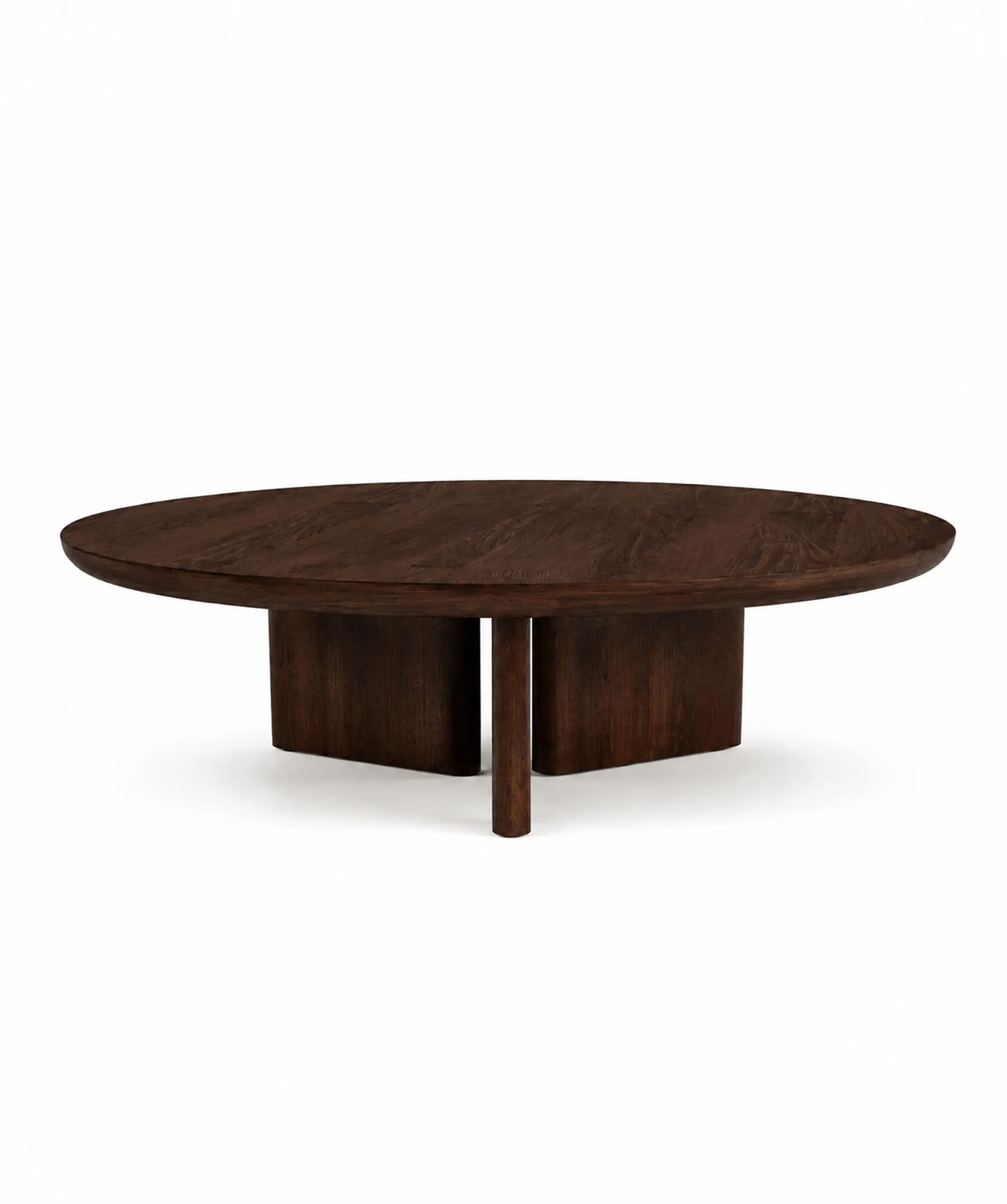
Yuka’s Offset Coffee Table follows this approach: a circular top on offset supporting pillars, giving an architectural form while keeping space to move around it.
9. Nesting Tables
Nesting tables fit together at different sizes and can be pulled apart when you need more surface. They suit living rooms that serve many purposes, or homes that host guests often.
How to Choose a Central Table for Your Living Room
Step 1: Measure your sofa. A common guideline is a table about two-thirds the sofa’s length.
| Sofa Length | Approximate Table Length |
|---|---|
| 72 inches | 48 inches |
| 84 inches | 56 inches |
| 96 inches | 64 inches |
These are planning examples, not fixed rules. Room size and shape matter too.
Step 2: Pick the shape.
| Shape | Suits |
|---|---|
| Round | Curved sofas, conversational seating |
| Rectangular | Long sofas, linear layouts |
| Square | Symmetrical seating, large sectionals |
| Oval | Long seating needing softer edges |
| Nesting | Flexible, multi-use rooms |
Step 3: Check the height. The table should be about the same height as the sofa seat or slightly lower. Too high feels intrusive; too low is inconvenient to use.
Step 4: Leave room to move. Allow roughly 16–18 inches between sofa and table, and aim for 30–36 inches of walking clearance where space allows.
Step 5: Match material to use. A busy family room needs easy cleaning and a durable surface. A formal drawing room can put more weight on appearance.
Step 6: Think about daily use. Do you need a large serving surface, a lower shelf for books, drawers, or rounded edges for kids?
Central Table Dimensions: What Size Is Best?
There is no universal size. Use these as starting points:
| Dimension | Guideline |
|---|---|
| Table length | About two-thirds of sofa length |
| Table height | Sofa-seat height or slightly lower |
| Sofa-to-table gap | About 16–18 inches |
| Main walking path | About 30–36 inches where possible |
| Small rooms | Prioritize compact size and circulation |
Example: an 84-inch sofa. 84 × 2/3 = 56 inches, so a rectangular table of around 56 inches is a good starting point. If the room has curved seating or tight circulation, a round table may work better.
Central Table Materials: Which Should You Choose?
| Material | Look | Main Thing to Check |
|---|---|---|
| Solid wood | Natural, warm | Wood species, joints, finish |
| Wood veneer | Natural wood surface | Veneer quality, substrate |
| Glass | Light, contemporary | Fingerprints, edges, safety rating |
| Natural marble | Distinctive, luxurious | Weight, staining, upkeep |
| Marble-look | Stone-inspired | What the surface really is |
| Metal | Contemporary, structural | Coating, corrosion, finish |
Inspect before buying
- Wood: joint quality, even finishing, stable base, what the core is made of.
- Glass: glass specification, edges, firm seating on the floor, weight limit.
- Marble and stone-look: actual top material, edges, weight, cleaning and stain protection.
Central Table Price in Pakistan
Central table prices in Pakistan vary widely. A simple compact table and a large designer centerpiece can sit in completely different price categories, even though both are called center tables.
What affects the price
- Material: solid wood, veneer, glass, metal and stone all cost differently.
- Size: bigger tops need more material and stronger structures.
- Design complexity: sculptural bases, curves and detailed finishing take more design and production work.
- Construction quality: frame, joints, supports and top all matter.
- Brand and craftsmanship: original design development, skilled workmanship and finishing standards.
Yuka central table prices
| Table | Price | Size (inches) | Description |
|---|---|---|---|
Offset Coffee Table |
Rs. 161,000 | 47 × 47 × 13 | Round table on offset supporting pillars, with a grounded look and open circulation space. |
| Trica Table | Rs. 98,000 | 46 × 46 × 14 | Low, wide accent table that pairs with the Tri-Tier Bed collection. |
Our tables are designed in-house by architects and built by our own craftsmen and technicians. That is what the price reflects: original design, proportion studies and controlled production, not a standard catalog table.
Buying insight: don’t compare tables by price alone. Compare dimensions, construction, actual materials, finish and intended use. A budget table and a designer centerpiece serve different purposes.
Central Table Designs for Different Room Sizes
Small living rooms. Choose compact round tables, slim profiles, nesting sets or glass tops with simple bases. Avoid oversized tops that take up most of the floor.
Large living rooms. You can use large rectangular tables, sculptural round tables, square tables for symmetrical seating, multi-piece nesting sets or statement bases. Even then, the largest table is not automatically the best; it should still relate naturally to the seating.
Drawing rooms. Coordinate with sofa upholstery, accent chairs, flooring, rugs and consoles. A wooden table adds warmth to a formal room, while glass or sculptural designs feel more contemporary.
How to Match a Central Table with Your Sofa
| Sofa Type | Table Options |
|---|---|
| Straight three-seater | Rectangular, oval or round |
| Four-seater | Large rectangular or round |
| L-shaped sectional | Round, square or rectangular |
| Curved sofa | Round or sculptural |
| Sofa with accent chairs | Round, oval or square |
The table does not need to match the sofa; it needs to work with it. A warm wooden table suits neutral fabric. A glass table lightens a heavy sofa. A sculptural table complements a simple sofa. A dark table contrasts with light upholstery.
Also think about the rug: the table, sofa and chairs should sit together on it as one group.
Common Buying Mistakes
- Not measuring the room first.
- Buying an oversized table that blocks movement.
- Ignoring sofa seat height.
- Choosing purely on looks, without thinking about daily use.
- Not asking what the table is actually made of.
- Forgetting maintenance: some finishes show fingerprints, dust and water marks easily.
- Overlooking stability.
- Forgetting delivery access: measure doors, stairs and lifts for large tables.
How to Maintain a Central Table
- Wood: dust with a soft dry cloth, use coasters, wipe spills quickly, avoid harsh cleaners and follow the finish care instructions.
- Glass: use glass cleaner and a microfiber cloth, avoid abrasives and check the base periodically.
- Marble and stone-look: clean spills promptly, avoid acidic cleaners on natural marble and follow sealing guidance.
- Metal: wipe with a soft cloth, avoid abrasive cleaners, keep dry and inspect joints and finish.
Why Choose a Designer Central Table from Yuka?
Yuka is a Pakistani furniture design brand founded by two architects. In-house designers, craftsmen and technicians develop each piece with attention to design, proportion and how furniture works in a real living space.
The Offset Coffee Table is a good example. Instead of conventional legs, its supporting pillars sit off-centre, giving it an architectural presence, and its round form softens a room full of straight lines.
What makes it distinctive
- Round top, 47 × 47 inches.
- Low profile, 13 inches high.
- Offset supporting pillars.
- Sculptural, architectural look.
- Designed with circulation around the table in mind.
Ready to compare? Browse our central table collection, view the Offset Coffee Table, or contact us with questions about sizes and purchasing.
Final Thoughts
The best central table is not the most expensive or the most elaborate. It is the one that suits your sofa, fits your room and works the way you live. Before buying, check shape, dimensions, construction, material, upkeep and how it relates to the rest of your furniture.
Frequently Asked Questions
1. Which central table design is best for a living room? It depends on your sofa, room size and style. Round tables suit curved seating and conversational layouts; rectangular tables suit longer sofas. Choose a design that complements the furniture around it and leaves room to move.
2. What is the central table price in Pakistan? Prices vary with size, materials, construction, design and brand, from simple compact tables to designer pieces. Compare specifications, not just price.
3. Which wooden central table design is best? It depends on your style and needs. Natural finishes suit warm, traditional and contemporary rooms; minimalist and sculptural wooden designs suit modern ones. Check the wood, construction and finish before buying.
4. Is a round or rectangular center table better? Round tables work well with curved sofas and compact conversational seating. Rectangular tables suit longer sofas and linear layouts. Choose according to room proportions and walking space.
5. What size central table should I choose? Start with about two-thirds of your sofa’s length, with the height at or slightly below the seat. Leave about 16–18 inches between sofa and table, and keep walking paths clear.
6. What is the difference between a central table and a coffee table? None in practice. Central table, center table and coffee table all describe a low table in a seating area.
7. Is solid wood better than veneer? Not always. Solid wood can often be refinished, while veneer can give a natural wood look at lower cost. Quality of construction and finish matters more than the label.
8. Are glass center tables suitable for family homes? They can be, if the glass is tempered, the edges are safe and the table is stable. Expect to wipe fingerprints more often.
9. Can I use a round central table with an L-shaped sofa? Yes. A round table softens the corner of a sectional and avoids sharp edges in a busy walkway. Check the diameter against your floor space.
10. Are nesting tables good for small rooms? Yes. You can keep them tucked together daily and separate them for guests.